
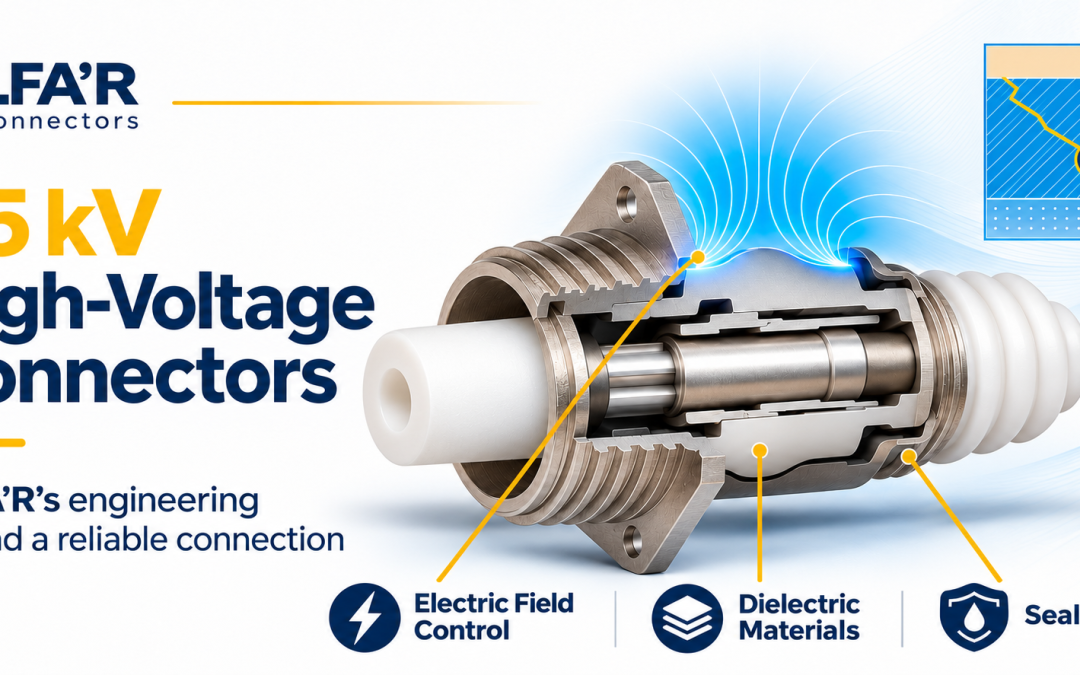
When we talk about 25 kV high-voltage connectors, a connector is much more than a component that joins two conductors. It is a critical engineering component designed to control electric fields, withstand dielectric stresses and ensure long-term reliability, even under demanding operating conditions.
At ALFA’R connectors, we approach the design of high-voltage connectors by taking all these factors into account. Selecting conductive materials and achieving good electrical contact is not enough. Different engineering solutions must be integrated to ensure safe and reliable operation.
What makes a 25 kV high-voltage connector reliable?
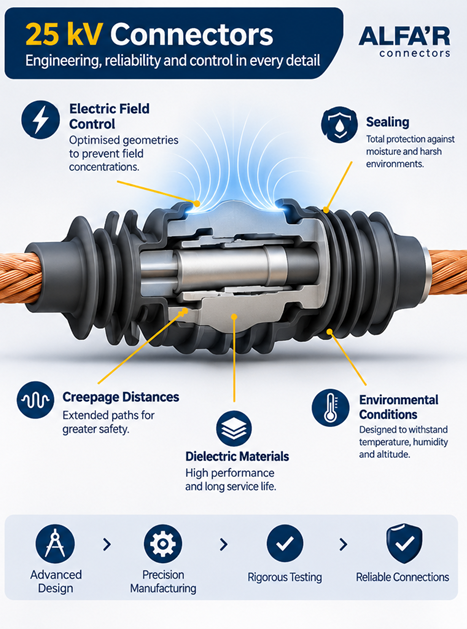
Reliability does not depend on a single factor. In 25 kV electrical connectors, electric field control, creepage distances, dielectric materials, sealing, environmental conditions, and manufacturing and testing precision all play an essential role.
These are the six fundamental aspects we consider at ALFA’R when designing and manufacturing our high-voltage connectors.
1. Electric field control: managing the invisible
One of the greatest challenges in high-voltage connector design is controlling the distribution of the electric field within the insulating structure. The geometry of the conductor, the insulation and the surrounding conductive elements directly influence this distribution.
Sharp edges, abrupt changes in geometry or poorly designed interfaces can cause local concentrations of the electric field, increasing the risk of partial discharges and, eventually, dielectric breakdown.
This is why electric field control, carefully designed geometries and the use of suitable electric stress grading elements are essential.
2. Creepage distances and insulation paths
Electricity always seeks the easiest path. In high-voltage connectors, it is essential to carefully assess both clearance distances through air and creepage distances along insulating surfaces.
In many designs, these surfaces incorporate extended, labyrinth-like or serpentine paths, increasing the distance that a potential leakage current would have to travel.
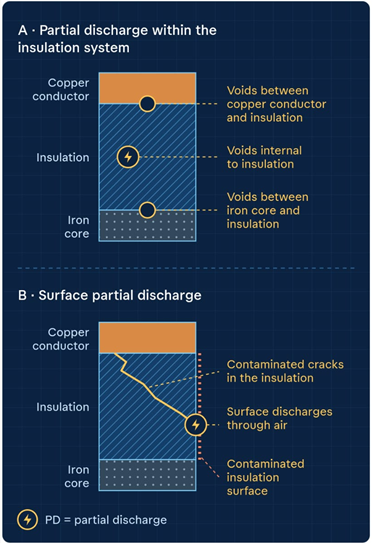
These solutions help reduce the risk of surface discharges and the formation of conductive paths, particularly in demanding environments. It is also essential to prevent unwanted electrical paths between elements operating at different electrical potentials.
3. Dielectric materials: much more than insulation
The selection of dielectric materials is another fundamental aspect of high-voltage connector design. Dielectric permittivity, dielectric strength, resistivity, thermal behaviour and resistance to ageing directly influence connector performance.
Analysing each material individually is not enough. It is necessary to study how they behave together, particularly at the interfaces between different components.
Small air cavities, microbubbles, discontinuities or inadequate compatibility between materials can cause local electric field concentrations and become initiation points for partial discharges. This is why material selection and manufacturing process control are inseparable.
4. Sealing and environmental protection
Moisture is one of the greatest threats to electrical insulation. Ambient humidity, condensation, dust and contamination can affect insulating surfaces and sealing interfaces, compromising dielectric performance.
For this reason, high-voltage connectors require carefully designed sealing systems and effective protection against the ingress of external agents. The objective is not simply to prevent water from entering, but to maintain stable insulation conditions throughout the connector's service life.
5. Environmental conditions also matter
A connector does not always operate under the same conditions in which it was tested. Temperature, relative humidity, atmospheric pressure and installation altitude can all influence its electrical performance.
For example, at higher altitudes, atmospheric pressure decreases, reducing the dielectric strength of air. This can affect the performance of clearance distances through air. Humidity and contamination can also affect surface insulation.
Therefore, electrical testing must consider controlled and documented environmental conditions, including temperature, relative humidity and pressure, in accordance with the applicable standards and test procedures.
6. Manufacturing and testing: where design becomes reliability
At ALFA’R connectors, we understand that even the best engineering design can fail if tolerances and manufacturing processes are not properly controlled.
Material homogeneity, surface finish, dimensional accuracy, assembly procedures and sealing quality are all determining factors.
Depending on the type of connector and the applicable standards, the validation process may include:
- Power-frequency withstand voltage tests.
- Partial discharge measurements.
- Insulation resistance measurements.
- Impulse voltage tests.
- Environmental testing and thermal cycling.
- Verification of sealing performance and protection against the ingress of external agents.
Each test provides essential information about the connector's ability to withstand demanding operating conditions.
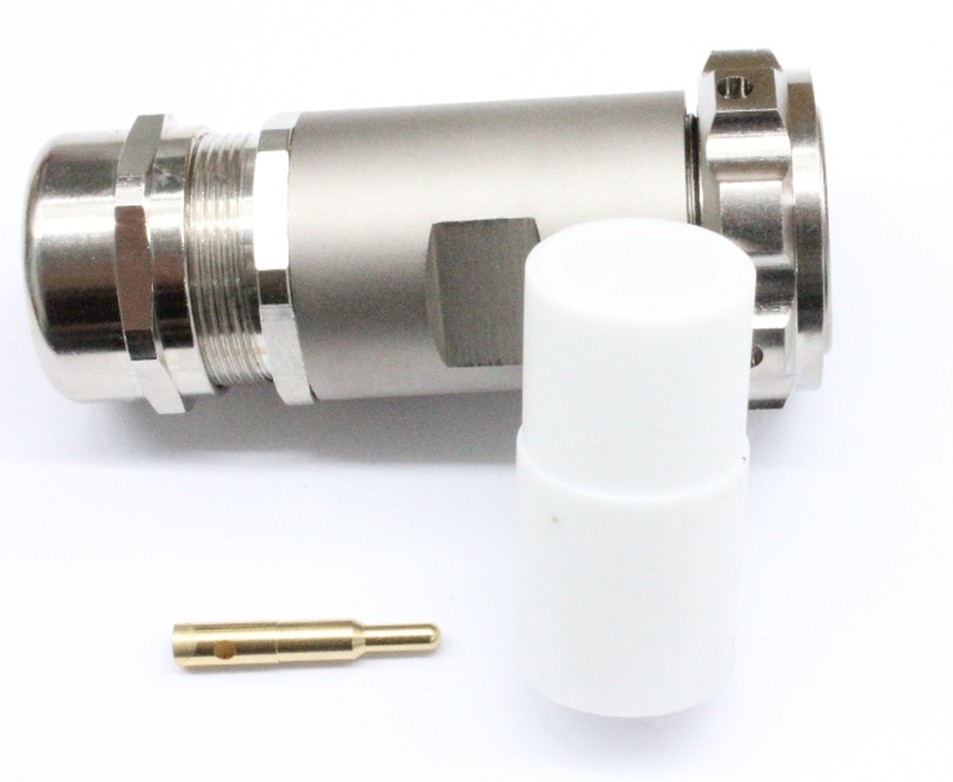
Examples of ALFA’R 25 kV high-voltage connectors
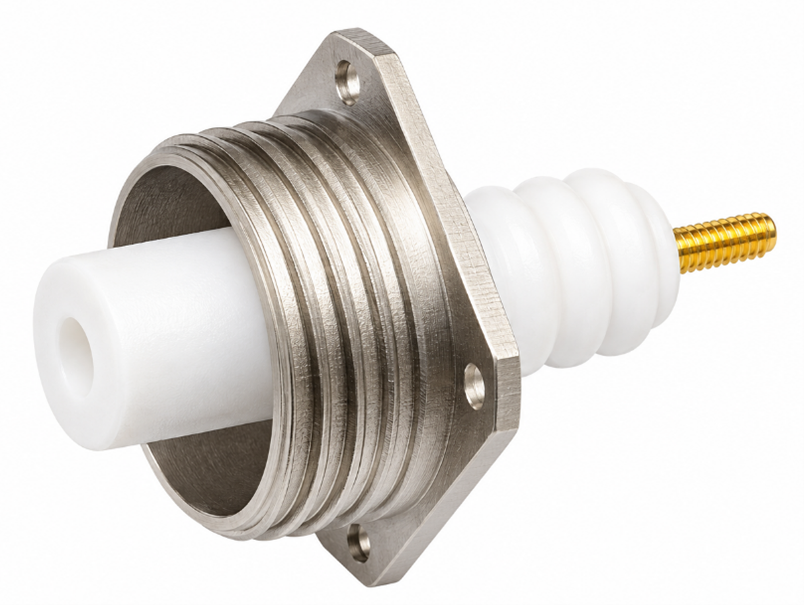
Engineering and reliability in 25 kV high-voltage connectors
Designing a reliable 25 kV connector means understanding how electric fields, materials, geometries, manufacturing processes and environmental conditions interact.
At these voltage levels, every detail matters. In many cases, the most important engineering decisions are precisely those that remain hidden once the connector has been assembled.
Because a reliable high-voltage connection is not simply about achieving good electrical contact. It is about controlling everything that happens around it.
At ALFA’R connectors, we work on each of these aspects to develop connection solutions tailored to the requirements of every application.
Looking for a connector for a specific application?
Contact our technical team to discuss your project's requirements and explore the most suitable connection solution.
Contact ALFA’RALFA’R connectors – Engineering reliable connections.